Electric Outboard Motors: All You Need To Know
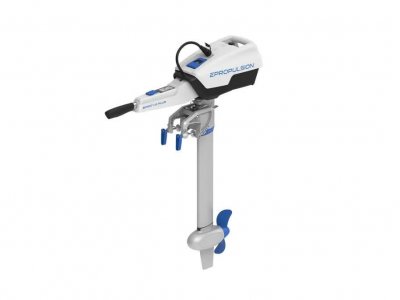
Electric outboards have moved from a niche curiosity to a legitimate option for small tenders and dinghies, but they work differently enough from petrol outboards that it's worth understanding the trade-offs before you buy one. This guide focuses on small electric outboards, in the vicinity of 3hp, and compares them against the two-stroke and four-stroke petrol outboards most boaters already know.
Electric outboards generally win on usability, with instant, smooth acceleration and no pull-starting required, and they're effectively zero maintenance since there's no oil to change or exhaust to foul your car or bunk. They're also cleaner, with zero emissions compared to the underwater exhaust of a petrol outboard, although how eco-friendly they are overall depends on how the battery is recharged. Where petrol still has a clear advantage is range, since current lithium-ion batteries hold roughly 10% of the energy density of petrol, which matters most for longer trips away from a charging point.
How Easy Are Electric Outboards To Use?
Electric outboards are straightforward to operate. There's no more wrestling with a pull-start cord, just press the power button and go. Acceleration is smooth and instant, which tends to make electric outboards appealing even to people who don't normally enjoy driving a tender or dinghy.
Many small electric outboards also separate the battery from the drive unit, which splits the total weight in two for easier transport and makes it simpler to remove the outboard from the transom. As an example, a typical setup might involve an 11kg motor and a separate 9kg battery, rather than a single heavier unit.
Maintenance is another point in their favour. There's no oil to leak and no exhaust soot to deal with, which means a cleaner boat, cleaner car, and cleaner storage area compared to a petrol outboard.
Are Electric Outboards More Eco-Friendly Than Petrol?
On the water, electric outboards produce zero emissions, compared to the underwater exhaust gases produced by petrol outboards. This is a clear benefit in nature reserves or other environmentally sensitive areas.
The full picture depends on how the battery is charged. If it's charged from solar panels or a similarly clean source, the environmental benefit is straightforward. If it's charged from a diesel generator, the equation is less clear-cut, though many boats already run a generator for other needs such as refrigeration or a watermaker, in which case the extra load from charging an outboard battery is a relatively minor addition. Overall, an electric outboard is generally the more eco-friendly option, though the exact margin depends on how it's recharged.
What Is The Real-World Range Of An Electric Outboard?
Range is where the difference between electric and petrol is most obvious. Current lithium-ion batteries hold approximately 10% of the energy density of petrol, so a 10kg lithium battery offers roughly the same usable energy as 1 litre of petrol.
This isn't a problem if you can recharge regularly and you're mainly using the outboard for short trips between shore and a moored boat, but it's a real limitation for longer journeys. As an example, one small electric outboard fitted to a 3.1m aluminium RIB reaching a top speed of 4.3 knots, gives around 55 minutes of runtime and a range of roughly 4 nautical miles. Throttled back to 3 knots, runtime extends to around 3 hours, for a range of about 9 nautical miles. Petrol outboards still hold the clear advantage for longer-range trips.
Electric outboards make a lot of sense for short trips, sensitive environments, and anyone who values simplicity over range, but petrol outboards still hold the advantage for longer journeys where recharging isn't an option. Which one suits you comes down to how and where you'll actually use it.
What Should You Look For When Choosing An Electric Outboard?
When comparing electric outboards, pay attention to power rating, whether the battery is detachable for easier transport, expected runtime at your typical cruising speed rather than just top speed, and how the outboard performs in wind and chop rather than only in flat, calm conditions. Video comparisons of current electric outboard models are widely available online and can be a useful way to see real-world performance before you buy.
Frequently Asked Questions
Are electric outboards as powerful as petrol outboards?
No. Small electric outboards, generally in the vicinity of 3hp, are designed for tenders and dinghies rather than for high-speed use, and they offer smooth, instant acceleration. For larger vessels or longer, faster trips, petrol outboards currently offer more power and significantly greater range.
How far can you travel on an electric outboard?
Range depends on speed and battery size. As an example, one small electric outboard on a 3.1m RIB achieves around 4 nautical miles of range at 4.3 knots, or around 9 nautical miles when throttled back to 3 knots. Petrol outboards generally offer significantly more range for the same weight of fuel or battery.
Are electric outboards better for the environment than petrol outboards?
Electric outboards produce zero emissions on the water, which is a clear advantage over petrol outboards in nature reserves and other sensitive environments. Their overall environmental benefit depends on how the battery is recharged, with solar or other clean charging sources offering the clearest advantage.
Do electric outboards need much maintenance?
Electric outboards require very little maintenance compared to petrol outboards. There's no oil to change, no exhaust to deal with, and no pull-start mechanism to wear out, which makes them considerably simpler to own day to day.